
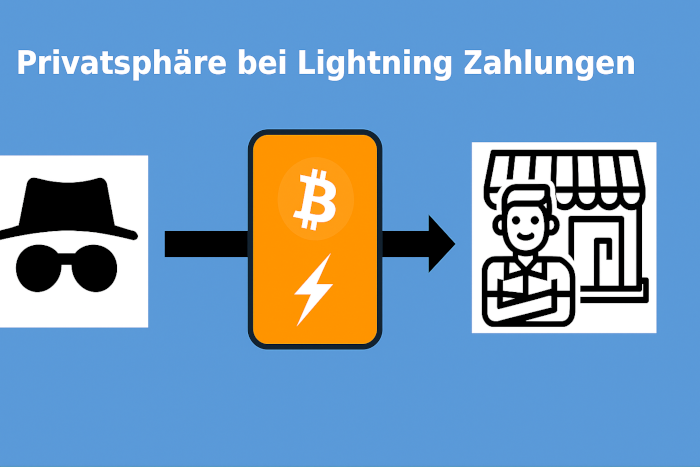
How private are Lightning payments really?
The simple guide for normal Bitcoin users (payers & merchants)
The Bitcoin Lightning Network is usually praised for two things:
-
it is extremely fast
-
it is extremely cheap
But many overlook perhaps the biggest advantage:
Lightning payments are surprisingly private – and completely automatic.
And the best thing about it:
You don’t need to know any technology, operate a node or carry out any complicated configuration.
In this article, you will find out in a simple and understandable way:
-
Why Lightning is so much more private than Bitcoin on-chain
-
Why self-custody lightning wallets are a game changer
-
how payers AND merchants are protected
-
what a Lightning Service Provider (LSP) is (simply explained!)
-
what Lightning does well – and also where its limits lie
Let’s go!
Why Lightning payments are automatically private
Bitcoin on-chain is transparent.
Any trader can theoretically see:
-
how much Bitcoin you own
-
what sources your money comes from
-
which transactions you have made before
It’s like showing your complete bank statement every time you go shopping.
Lightning works completely differently.
✔ Lightning payments do not run via the blockchain
They take place off-chain.
There are:
-
No entries in the blockchain
-
no addresses
-
no UTXOs
-
No permanent trace
-
No publicly visible amounts
This makes Lightning like digital cash:
You pay – and the information disappears again immediately.
Lightning protects the payer (sender)
Lightning has become particularly easy for normal users because almost all modern Lightning wallets are self-custodial:
-
Phoenix
-
Breez
-
Mutiny
-
Zeus (with LSP)
-
Alby
-
Wallet of Satoshi (new self-custody version)
-
Blink (still custodial, self-custody in progress)
This applies:
✔ 1. you leave no on-chain traces
You do not open any channels.
You do not close any channels.
Everything is done by the wallet provider or the LSP in the background.
➡️ You do not appear in the blockchain data traffic.
✔ 2. no registration – no identity data
You don’t have to register or enter any personal data:
-
No e-mail
-
No telephone number
-
No KYC
-
No account
You are simply you – without a login, without a profile, without data traces.
✔ 3. the merchant does NOT see your Bitcoin assets
With on-chain payments, a merchant sees your entire wallet history.
With Lightning, he sees:
-
the amount
-
the time
And NOTHING else.
Neither:
-
your coins
-
your history
-
your origin
-
your future payments
➡️ Lightning protects your privacy automatically – without any effort.
Lightning also protects the retailer (recipient)
Not only payers benefit – retailers do too.
A merchant who receives Lightning payments also remains anonymous:
✔ 1. he does NOT show the customer his wallet history
A payer sees:
-
no addresses
-
no UTXOs
-
No sales history
✔ 2. no separate node required
Traders used to have to:
-
operate a Lightning Node
-
Open channels
-
Manage liquidity
-
Guarantee 24/7 uptime
Today, this is done by a Lightning Service Provider (LSP ).
retailers simply use it:
-
BTCPay Server + LSP
- Coinsnap
-
Breez POS
-
Alby Hub
-
Zeus Merchant
-
or any self-custody wallet
✔ Dealers do NOT have to do anything technical
It works like normal payment – simple and private.
What is a Lightning Service Provider (LSP)?
An LSP is like an “infrastructure service provider” in the background.
It ensures that your Lightning Wallet:
-
is always connected to the network
-
always has sufficient liquidity
-
Payments arrive reliably
-
everything works automatically
You yourself:
-
hold the private keys
-
control your money
-
do not need to understand technology
One sentence that explains everything:
An LSP makes Lightning possible – but he doesn’t know who you are.
Disadvantage: Large Lightning Service Providers lead to centralization
For it to work so easily, Lightning needs large nodes that are very reliable.
This leads to a disadvantage:
❗ A few large LSPs operate a large part of the Lightning Network.
This means:
-
the network is not as decentralized as the Bitcoin blockchain
-
individual LSPs could see a lot of technical data (but no identities)
BUT:
✔ For users, this means:
more privacy, less effort, no node management.
The reality is:
A little centralization at the LSPs leads to much more privacy for normal users.
Lightning Privacy: It’s that simple for everyday life
-
Timing correlation possible
-
Large payments are often split
-
Centralized LSPs = more routing power
-
IP analysis possible without Tor/VPN
-
Custodial wallets (like Blink currently) have less privacy
Yes, it is:
➡️ In practice, Lightning risks are lower than Bitcoin on-chain risks.
Lightning vs. privacy coins (Monero, Zcash)
The following applies to payers and retailers today:
-
Install Lightning Wallet
-
Scan QR code
-
pay or receive
-
finished
No technology.
No configuration.
No blockchain analysis.
No identity data.
Lightning is the easiest way to use Bitcoin privately.
Conclusion: Lightning turns Bitcoin back into digital cash
The Lightning Network brings a level of privacy that Bitcoin on-chain could never offer.
✔ No on-chain tracks
✔ no KYC
✔ no addresses
✔ No asset visibility
✔ No dealer data
✔ No registration
✔ No node management
✔ Very private – completely automatic
Today, Lightning is the best, simplest and most practical way to pay privately with Bitcoin.
FAQ: Lightning Privacy
Is Lightning anonymous?
Fast: Lightning is very private. The blockchain does not see your payment.
Can the merchant see how much Bitcoin I have?
No, Lightning prevents that completely.
Do I need KYC?
No, self-custody wallets work without accounts or personal data.
Do I have to operate a node for this?
No. Modern wallets do everything automatically.
Is Lightning complicated?
No – it’s even easier than Bitcoin on-chain.