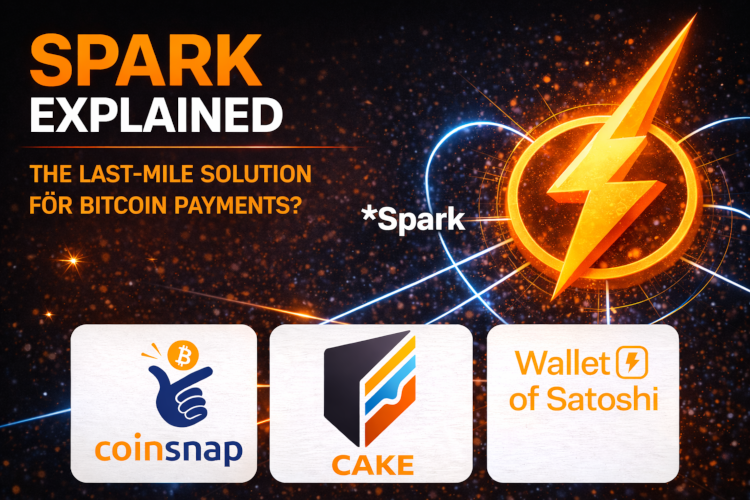
Spark explains
The last-mile solution for Bitcoin payments?
Why Spark is becoming increasingly important for wallets, merchants and Bitcoin payments
Anyone who deals with Bitcoin payments quickly realizes:
After Bitcoin Onchain and Lightning, further Bitcoin payment layers and last-mile solutions are emerging.
One of the most exciting developments is Spark.
Spark wants to solve a problem that many Bitcoin users and wallet providers have known for years:
How can Bitcoin payments be made easily, quickly and self-custodially usable without users having to operate a Lightning Node, manage channels or deal with liquidity?
This is exactly where Spark comes in. According to Lightspark, Spark is a Bitcoin-native Layer 2 or settlement infrastructure that allows developers to build instant, low-cost and self-custodial Bitcoin payments that are also natively interoperable with Lightning.
Spark is therefore particularly interesting for people who want to pay with Bitcoin, for wallet providers and for merchants who want to accept Bitcoin.
What is Spark simply explained?
Spark is an additional Bitcoin payment layer designed to make everyday Bitcoin payments easier.
Simply put:
- Bitcoin Onchain is the basis.
- Lightning makes Bitcoin payments fast and cheap.
- Spark is designed to make the use of Bitcoin and Lightning even easier – especially for wallets, mobile payments and payment recipients.
Spark describes itself as an infrastructure that enables wallets and apps to offer self-custodial lightning payments without nodes, channels or liquidity problems for the user.
So the goal is not to replace Lightning.
The goal is to make Bitcoin payments via Lightning and Spark more suitable for everyday use for normal users.
Why Spark is considered a last-mile solution
The term last-mile solution fits quite well with Spark.
Because Spark takes care of exactly the part where Bitcoin payments often became complicated for normal users:
- Receipt of payments
- Mobile use
- Simple wallet setup
- Self-custody without Lightning tinkering
- Better user experience when sending and receiving
A particularly strong argument is that Spark supports true offline receive for Lightning interoperability. The Spark documentation describes that the receiver does not need to be online to receive a full Lightning payment. Furthermore, the receiver does not need a Lightning node, channels or force closures.
This is precisely why Spark is not a pure back-end technology for many observers, but a genuine last-mile solution for Bitcoin payments.
What advantages Spark offers
1. self-custody without the classic Lightning effort
One of the biggest advantages of Spark is that
users should be able to store their Bitcoin themselves without having to operate their own Lightning infrastructure.
Spark explicitly positions itself as a solution for self-custodial Lightning Wallets, where users do not have to manage nodes, channels or liquidity logic.
2. compatible with Lightning
Spark is not positioned as a competitor to Lightning, but as a Lightning-compatible infrastructure. Lightspark describes Spark as Bitcoin-L2, which makes it possible to send and receive natively via Lightning.
3. fast and favorable payments
Lightspark promotes Spark as an infrastructure for instant payments with near-zero costs. This makes Spark particularly interesting for mobile wallets and payment apps.
4. offline-receive
The fact that users can receive payments without having to be online is one of the most practical differences to classic Lightning setups. This is a real advantage, especially for mobile wallets and point-of-sale scenarios.
5. simple integration for wallets
Wallet providers can integrate Spark either directly via the Spark Wallet SDK or via integrations such as Breez SDK. Spark and Breez position this as a fast way to provide self-custodial Lightning and Spark payments with additional features such as Lightning Address, LNURL and multiple platform bindings.
What disadvantages and trade-offs Spark has
As exciting as Spark is, the article should also clearly state the disadvantages.
1. privacy is not automatically perfect
With Sparkscan, Spark has an official public explorer for transactions, addresses and network activity. Spark also documents a privacy mode in which public APIs and explorers no longer return any data. This shows quite clearly:
Visibility can arise without suitable privacy settings or privacy-focused wallet implementation.
2. the wallet implementation makes a big difference
Not all Spark wallets are the same.
Whether a Spark wallet is more openly visible or more privacy-oriented depends heavily on the specific integration. Spark itself documents, for example, that wallets can optionally embed a Spark Address or a Spark Invoice when generating Lightning Invoices.
3. new protocol, young ecosystem
Spark is live, but is still a comparatively young ecosystem. Lightspark itself initially described Spark as a beta. Anyone using or integrating Spark is therefore still operating in a young market with a corresponding development risk.
4. additional infrastructure and operational dependencies
Wallet of Satoshi explicitly states in its Disclosure Document that the self-custody function depends on a third-party Layer 2 system from Lightspark and that this may incur additional fees and operational risks.
Why wallets integrate Spark
The simple answer is:
Because Spark defuses the big wallet problem: bringing together good UX and self-custody.
For a long time, wallets often had to choose between:
- simple user experience, but rather custodial
- Self-custody, but technically complicated lightning use
Spark promises a middle ground here.
Spark explicitly advertises its infrastructure for wallets that want to deliver “real Lightning payments with real self-custody” – without node operation, channels and liquidity problems.
This is attractive for wallet providers because they:
- can go live faster
- need to build less Lightning complexity of your own
- be able to offer self-custody
- Bitcoin, Lightning and Spark can merge
Wallet of Satoshi: Spark for self-custody
Wallet of Satoshi: Spark in practice – with a clearly recognizable privacy disadvantage
Wallet of Satoshi is one of the best-known examples of Spark in practice. For users in Europe and the USA, Wallet of Satoshi is now only offered in the App Store as a self-custody solution based on Spark for regulatory reasons.
This is remarkable because Wallet of Satoshi has long been known primarily as a particularly simple Lightning wallet. With Spark, Wallet of Satoshi can now continue to offer a very simple user experience without users having to operate a Lightning node themselves, manage channels or deal with classic Lightning complexity.
The disadvantage of Wallet of Satoshi
However, Wallet of Satoshi also reveals an important disadvantage of this implementation:
The corresponding Spark address can be derived from the wallet-of-Satoshi-Lightning address.
If you know this Spark address, you can then call it up via Sparkscan. This makes it visible:
- which transactions have been made via this wallet
- how high the current credit balance is
In practice, this Spark wallet behaves somewhat similarly to a Bitcoin onchain address, which can also be viewed publicly in a block explorer.
Practical example: How to test it yourself
If you want to understand this, you can try it out for yourself:
-
Take a Wallet-of-Satoshi-Lightning address.
-
Enter them on the following page:
https://reneaaron.github.io/spark-lnaddress-doxxer/ -
The corresponding Spark address is derived from the Lightning address.
-
You then enter this Spark address here:
https://sparkscan.io/?network=mainnet -
You can then see which transactions belong to this Spark address and how high the current wallet balance is.
This makes it very clear that while Spark can provide a simple self-custody experience, the specific wallet implementation has a major impact on privacy.
Important: This does not apply to all Spark wallets
This point is important:
This behavior does not apply to all wallets that use Spark.
With Coinsnap, Cake Wallet and other Spark wallets, this derivation from the Lightning address is not possible. This means that the Spark address cannot be determined in this way and the balance or transaction history subsequently made visible via Sparkscan.
This shows very clearly what is important for Spark in practice:
It is not only Spark itself that is decisive, but above all the type of implementation in the respective wallet.
Why this is important for comparison with other Spark wallets
Wallet of Satoshi is a particularly interesting example because it demonstrates two things at the same time:
On the one hand, Spark enables self-custody and a simple user experience.
On the other hand, the specific implementation can lead to significantly weaker privacy than with other Spark wallets.
For users, this means:
When comparing Spark wallets, you should not only pay attention to whether a wallet uses Spark, but also how Spark has been integrated.
See also: Wallet of Satoshi
Cake Wallet: Spark via Breez
Cake Wallet is another important example.
Spark itself writes that Cake Wallet rolled out self-custodial Lightning via the Breez SDK, built on Spark infrastructure, to more than 1 million users in early March 2026.
This shows an interesting difference to Wallet of Satoshi:
Cake Wallet does not rely on a pure direct integration of Spark, but on the path via Breez.
This is important because Breez offers additional functions and abstractions, for example for:
- Lightning Address
- LNURL
- Multi-platform bindings
- nodeless Lightning integration
Spark explicitly documents Breez as a convenient integration path for developers who want to integrate more than just the basic functions of Spark.
Advantage for Cake Wallet
The advantage is obvious:
Cake Wallet can integrate Lightning and Spark functionality without having to build the entire complexity from scratch. At the same time, the wallet remains self-custodial.
Coinsnap Wallet: point of sale and self-custody wallet in one app
A particularly practical example of Spark in retail is the Coinsnap wallet.
Coinsnap positions the solution as a self-custodial Bitcoin wallet with an integrated point of sale, which was specially developed for use in stationary retail. On the POS page, Coinsnap describes the app as “The Bitcoin Point of Sale Wallet for Real-World Business” and emphasizes that payments are credited directly to the user’s own wallet – without an exchange account, without custody risk and without technical complexity.
According to the product page, the Coinsnap Wallet is primarily aimed at companies with direct customer contact, for example:
- Cafés
- Retail trade
- Food Trucks
- Market stalls
- Event stands
- Service companies
At the same time, the solution is also interesting for other areas of application:
- for merchants who want to receive Bitcoin payments in the store directly on their own wallet
- for Coinsnap merchants who want to combine wallet and acceptance solution in one app
- for users looking for a simple self-custodial Bitcoin wallet with Lightning, Spark and on-chain support
The Coinsnap Wallet combines wallet and point of sale in one app and provides support:
- self-custodial Lightning
- Spark Payments
- Bitcoin Onchain
- your own Lightning Address
- Bitcoin-native representation in Satoshis
- Fiat values for reference only
The additional point-of-sale functions that Coinsnap mentions on the POS page are particularly exciting for retailers:
- Amount entry via keypad
- Product catalog
- Bitcoin discounts
- Separate terminals per employee
- Integrated tipping function
- Tips directly to the Lightning Wallet of the respective employee
This makes Coinsnap one of the most interesting Spark examples in the merchant sector, because Spark is not only used here as a wallet technology, but also as a practical last-mile solution for Bitcoin payments in stationary retail. Coinsnap itself writes that Spark is used to provide a “smooth self-custodial Lightning experience”.
Why Coinsnap is a particularly good fit for Spark
Coinsnap is therefore not just another Bitcoin wallet, but a merchant-first developed Bitcoin point-of-sale wallet. This fits in very well with Spark.
This is particularly attractive for small retailers, because they are primarily:
- Simply accept Bitcoin payments
- Use a mobile solution
- do not operate their own Lightning infrastructure
- retain full control over their Bitcoin
- want to work without an exchange and without third-party custody.
This is precisely where Spark comes into its own:
fast payments, self-custody, Lightning compatibility and ease of use at the point of sale. Coinsnap combines these features with an interface clearly geared towards merchants and functions for real cash register operations.
Direct Spark integration vs. Spark via Breez
An important point for wallet providers is the question:
Build directly on Spark or integrate Spark via Breez?
Direct Spark integration
With direct Spark integration, the wallet uses the Spark SDK directly. Spark documents its own wallet SDKs and APIs for wallet management, Bitcoin, Lightning and other functions.
Advantages:
- Direct access to Spark functions
- More control over the implementation
- Potentially leaner architecture
Disadvantages:
- More personal effort for Wallet team
- more responsibility for UX, Lightning Address, LNURL and additional logic
Spark about Breez
When integrating via Breez, the wallet uses the Breez SDK, which Spark integrates in the background. Spark documents Breez as a way for developers who want to integrate self-custodial Lightning and Spark payments with additional functions with little effort.
Advantages:
- Faster integration
- Many ready-made functions
- Lightning Address, LNURL and other features already integrated
- less personal effort
Disadvantages:
- more abstraction
- less direct control over individual Spark-specific details
- Additional dependency on Breez as SDK layer
What users get from a Spark wallet
For normal users, the added value of a Spark wallet is pretty clear:
- Self-custody, without the classic Lightning operating stress
- Fast payments
- Low fees
- Easier wallet experience
- Offline-Receive as a practical advantage
This is particularly interesting for people who want to pay with Bitcoin without having to use Lightning “as a hobby”.
What payees have from Spark
Spark also offers clear advantages for payment recipients – i.e. merchants, self-employed persons, POS users or online merchants:
- Payments can be received more easily
- No separate Lightning Node is required
- Self-custody remains possible
- Mobile wallets and POS solutions are becoming more practical
- Lightning complexity disappears more into the background
This is precisely why Spark is not only interesting for wallet apps, but also for payment solutions and Bitcoin acceptance in retail.
Conclusion: Spark is more than just another Bitcoin layer
Spark is not just a technical gimmick, but a serious last-mile solution for Bitcoin payments.
The big attraction is that Spark wants to bring together several things that were previously difficult to combine:
- Self-Custody
- Simple user experience
- Lightning interoperability
- Fast and favorable payments
- Better reception logic for mobile wallets and merchants
The fact that wallets such as Wallet of Satoshi and Cake Wallet are already using Spark shows why the topic is becoming increasingly important. And if the Coinsnap wallet goes live as announced as a self-custodial wallet with an integrated point of sale, Spark will also become even more relevant for brick-and-mortar retailers and merchants who want to accept Bitcoin.
The most important finding is therefore:
After Onchain and Lightning, further Bitcoin payment layers and last-mile solutions are emerging. Spark is currently one of the most exciting of these.
FAQ: Spark, Lightning and Bitcoin payments
What is Spark with Bitcoin?
Spark is an additional Bitcoin payment layer designed to make Bitcoin and Lightning payments easier, faster and self-custodial. Spark is natively interoperable with Lightning and is particularly aimed at wallets and payment apps.
Is Spark a replacement for Lightning?
No. Spark is not intended as a replacement for Lightning. Spark is Lightning-compatible and aims to simplify the use of Bitcoin and Lightning payments for wallets and users.
Why is Spark considered a last-mile solution?
Because Spark addresses exactly the problems that arise in the everyday use of Bitcoin payments: complicated wallet setup, channel management, liquidity and offline receive.
What are the advantages of Spark?
The most important advantages include self-custody without the classic Lightning effort, Lightning compatibility, fast and inexpensive payments, offline receive and simpler integration for wallets.
What are the disadvantages of Spark?
The disadvantages include possible privacy trade-offs, a still young ecosystem and additional infrastructure dependencies. The extent to which these points come into play also depends on the wallet implementation in question.
Why do Wallet of Satoshi and Cake Wallet use Spark?
Because Spark gives wallets the opportunity to offer self-custodial Lightning payments with a better user experience, without users having to operate Lightning infrastructure themselves.
What is the difference between Spark direct and Spark via Breez?
With direct Spark integration, the wallet uses Spark directly via the Spark SDK. When integrating via Breez, the wallet uses the Breez SDK, which integrates Spark in the background and provides additional functions such as Lightning Address and LNURL.
Is Spark interesting for retailers?
Yes, Spark is particularly interesting for merchants who want to accept Bitcoin payments easily, mobile and self-custodially. This applies in particular to wallets or POS solutions with Spark support.
What is the Coinsnap Wallet?
The Coinsnap wallet is a self-custodial Bitcoin wallet with an integrated point of sale for merchants. It supports Lightning, Bitcoin Onchain and Spark Payments and makes it possible to receive Bitcoin payments directly on your own wallet. According to Coinsnap Wallet, it is primarily aimed at stationary retailers and companies with direct customer contact.