

Bitcoin acceptance 2026
The River study “What’s driving Bitcoin adoption in 2026?“ shows a clear trend: Bitcoin adoption in 2026 will grow primarily where merchants can easily integrate Bitcoin payments. More merchants, strong growth in lightning and new POS integrations are important signals for retail in the USA – and also for Europe and the DACH region in the future.
What the River study shows about merchants and Bitcoin payments
Bitcoin is often still seen primarily as a store of value or investment. However, the River study “What’s driving Bitcoin adoption in 2026?“ shows that Bitcoin is also evolving as a payment method. Three developments are particularly relevant for merchants: more merchants accepting Bitcoin, a rapidly growing Lightning Network and new integrations into existing payment systems.
This is an important signal for companies, online stores and brick-and-mortar retailers. This is because Bitcoin payments are not only becoming more technically sophisticated, but also more practical to use. The study makes it clear that Bitcoin acceptance is growing, especially where merchants can easily integrate Bitcoin payments into existing processes.
Bitcoin acceptance 2026: More and more merchants accept Bitcoin
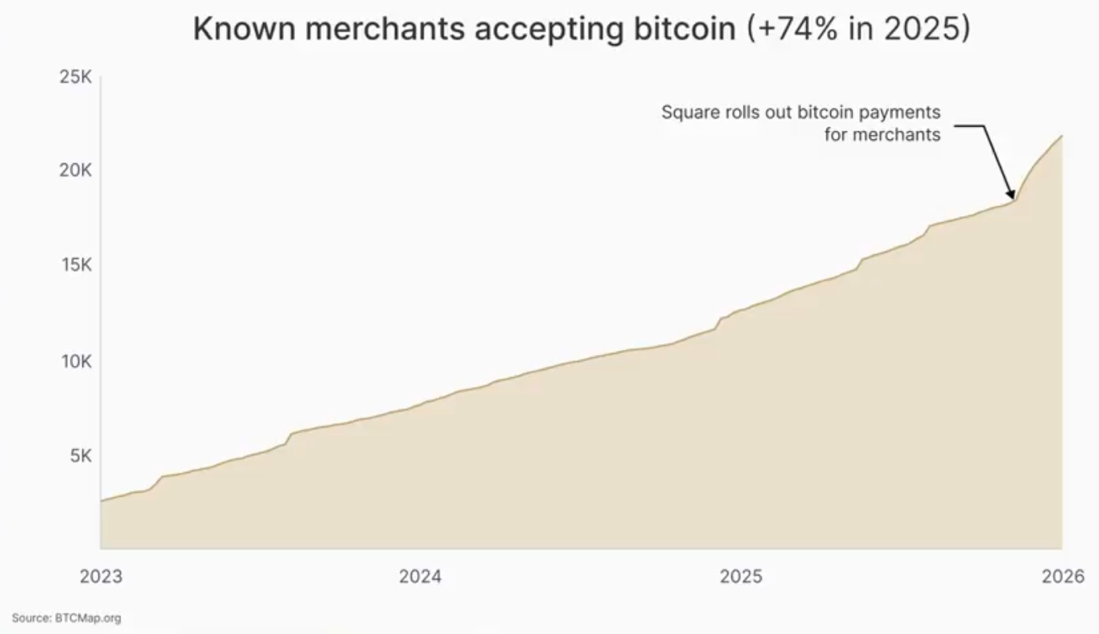
A key finding of the River study is the growth in merchant acceptance. On the merchant side, River shows that the number of known merchants accepting Bitcoin has increased significantly in 2025. Growth is particularly strong in North America. There, the study lists 6,535 merchants and growth of +4,299 or +192 %. Europe is still slightly ahead with 6,745 merchants, but is growing more slowly. South America, Africa, Asia and Oceania are also growing.
The study thus shows that Bitcoin payments are no longer just a niche topic. More and more merchants are accepting Bitcoin, and the development is visible internationally. For companies dealing with Bitcoin payments, this is a clear indication that the market is opening up further.
Why Bitcoin acceptance will grow particularly strongly in the USA in 2026
River cites two key reasons for the strong growth in North America: a more favorable regulatory environment and the introduction of integrations into existing payment networks such as Square. This point is particularly important for merchants. New payment methods don’t usually catch on because they are technically interesting, but because they are easy to integrate into existing checkout systems and processes.
If Bitcoin payments can be activated directly via existing POS systems or payment providers, the hurdle for merchants is significantly lowered. Bitcoin is then no longer perceived as a special solution, but as an additional payment method within the existing infrastructure. This is an important difference. Because it is precisely such integrations that make broad merchant adoption more likely.
Lightning Network and Bitcoin acceptance 2026
This development becomes even clearer when looking at the Lightning Network. River shows that the Lightning volume grew by 300% in 2025. This is a strong signal that Bitcoin payments are becoming faster, cheaper and more suitable for everyday use. This is crucial for merchants, as a payment method must be reliable, efficient and easy to use.
The study also shows that Lightning is no longer only characterized by micropayments. According to River, the average Lightning transaction size is increasing from 24 US dollars and 12 US dollars in earlier periods to 118 US dollars and finally to 223 US dollars in November 2025. This suggests that Lightning is also increasingly being used for regular payment transactions and not just for small test or niche payments.
What the River study shows about Bitcoin as a payment method in retail
The River study thus shows more than just individual growth figures. It describes a structural change. Bitcoin is developing in retail not just through persuasion or attention, but through better infrastructure, growing use of lightning and integration into existing payment systems.
For merchants, this means that Bitcoin acceptance will grow above all where the technical hurdle is lowered and use is as uncomplicated as possible for merchants. It is not the isolated individual solution that is driving development, but integration into existing processes.
What Bitcoin acceptance in the USA in 2026 means for Europe and the DACH region
The study focuses heavily on North America. This is precisely why it is interesting for Europe. This is because many payment innovations first appear in large, highly digitized markets and become visible in other regions with a time lag. The US development is therefore not an exact roadmap for Europe, but it is a relevant early indicator. This classification is a derivation based on the market dynamics shown in the River study.
For merchants in the DACH region, this means that Bitcoin payments will not be standard across the board tomorrow. But the market movement is clearly recognizable. If POS integrations, lightning infrastructure and regulatory opening in the USA lead to greater merchant acceptance, it is plausible that similar developments will also gain importance in Europe.
What merchants can now deduce from Bitcoin acceptance in 2026
The River study provides three particularly important signals for companies and merchants. Firstly, the number of merchants accepting Bitcoin is growing measurably. Secondly, Lightning improves the practical usability of Bitcoin as a payment method. Thirdly, integrations into existing payment systems show that Bitcoin payments scale particularly well when they are simply embedded into existing processes.
For merchants, this means that Bitcoin acceptance is much less experimental today than it was a few years ago. Those who get to grips with the topic early on can better assess whether and how Bitcoin payments can be integrated into their own business model.
Conclusion: Bitcoin acceptance continues to grow in 2026
The River Study 2026 clearly shows that Bitcoin is developing positively as a payment method. The number of merchants is increasing, the Lightning Network is growing strongly and major integrations into existing payment networks are making it easier for merchants to use. The development in the USA in particular shows how Bitcoin payments are gaining relevance when they are easily integrated into existing payment processes.
This is an important signal for companies in Europe and the DACH region. The dynamics from the US are unlikely to be transferable one-to-one, but can serve as an indication of where the market for Bitcoin payments in retail is heading.
To the River Study Bitcoin Adaption 2026: https: //river.com/content/bitcoin-adoption-2026
FAQ on Bitcoin acceptance 2026, merchants and Lightning
What does Bitcoin acceptance mean in 2026?
Bitcoin Acceptance 2026 describes the growing use of Bitcoin as a payment method in retail. The River study shows that more merchants are accepting Bitcoin, the Lightning Network is growing strongly and POS integrations are simplifying its use.
What does the River study on Bitcoin acceptance in 2026 show?
The River study “What’s driving Bitcoin adoption in 2026?” shows that the acceptance of Bitcoin is increasing in several areas. Particularly relevant for merchants are the increasing number of bitcoin-accepting merchants, the growth of Lightning and new integrations into existing payment systems.
Why is Bitcoin acceptance growing in retail in 2026?
According to River, Bitcoin acceptance in retail is growing, especially where merchants can easily integrate Bitcoin payments into existing checkout systems, POS solutions and checkouts. In North America in particular, the study sees integrations into existing payment networks such as Square as an important growth driver.
What role does Lightning play for Bitcoin acceptance in 2026?
According to River, the Lightning Network is a key driver for Bitcoin as a payment method. The study shows that the Lightning volume grew by 300% in 2025. At the same time, the average transaction size is increasing, which indicates a broader use for real payment transactions.
What does the development in the USA mean for retailers in Europe?
The River study primarily describes the dynamics in North America. It can be deduced from this that developments in the USA can also be relevant for Europe, often with a time lag. For the DACH region, this is an indication that Bitcoin payments could gain in importance as a merchant topic. This conclusion is an editorial classification based on the study.
Is Bitcoin acceptance already a mass market in 2026?
The study shows clear growth, but not yet full market penetration. According to River, Bitcoin payments are moving towards wider use, especially through Lightning and POS integrations. However, it is not yet possible to speak of a comprehensive standard.
Free initial consultation

If you would like to accept Bitcoin payments, arrange your free initial consultation with us now.