
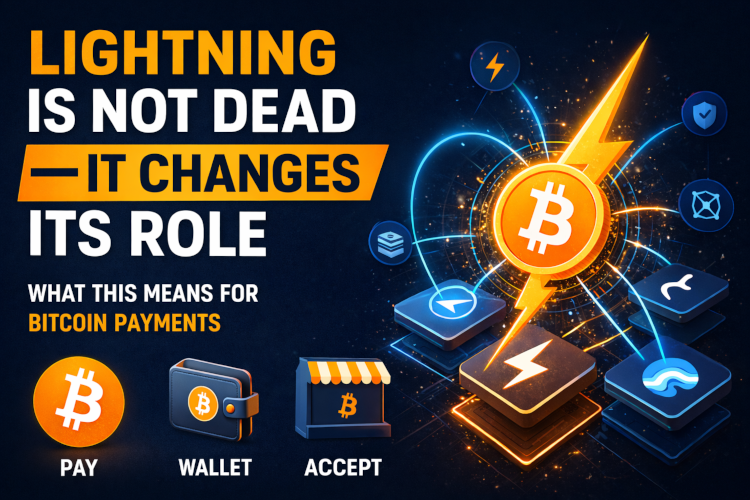
Lightning is not dead
Why Lightning is becoming more important than ever for Bitcoin payments
What Roy Sheinfeld’s article means for people who want to pay with Bitcoin or accept Bitcoin
Anyone who deals with Bitcoin payments will sooner or later come across the Lightning Network. For a long time, Lightning was considered the most important answer to the question of how to pay quickly and cheaply with Bitcoin. At the same time, Lightning was associated with technical complexity for many users: Node operation, channels, liquidity and routing.
However, a recent article by Roy Sheinfeld entitled “Lightning Is Dead, Long Live Lightning!“ shows that the role of Lightning is changing. Lightning is not disappearing. Instead, Lightning is evolving from a visible end-user technology to a behind-the-scenes infrastructure that connects various Bitcoin payment systems.
For anyone who wants to know how to pay with Bitcoin, how to accept Bitcoin or what role Lightning will play for Bitcoin as a payment method in the future, this development is very important.
What is Roy Sheinfeld’s key message?
The central message of the article is:
Lightning has not failed. Lightning is changing its function in the Bitcoin ecosystem.
In the past, Lightning was often understood as a system that users had to actively operate themselves or understand directly. This included:
- Lightning Node
- Payment Channels
- Inbound and outbound liquidity
- Routing
- Technical management of payment channels
Roy Sheinfeld argues that this model was not ideal for many normal users. In practice, people don’t want to know how a payment channel works. They just want to:
- Paying with Bitcoin
- Receive Bitcoin
- Send fast payments
- pay low fees
- Use a wallet or payment solution that works reliably
This is exactly where Lightning is changing. Lightning is increasingly becoming the connection layer between different Bitcoin payment solutions.
Why the classic Lightning model was too complicated for many users
The classic Lightning model was technologically innovative, but also presented challenges. These include:
- High technical effort
- Complex user guidance
- Difficult liquidity management
- Limited offline capability
- Synchronization problems with mobile applications
- Limited suitability for everyday use for less tech-savvy users
This does not mean that the Lightning Network works badly. Rather, it means that the direct use of Lightning was too complicated for many people who only wanted to use Bitcoin in everyday life or accept Bitcoin payments.
With mobile wallets and everyday payment applications in particular, it became clear that good technology alone is not enough. The user experience determines whether Bitcoin is actually used as a payment method.
New Bitcoin payment layers change the role of Lightning
In the article, Roy Sheinfeld describes several new technologies that have gained in importance in recent years. These include, among others:
- Spark
- Liquid
- Fedimint
- Cashu
- Arcade
These solutions have different technical approaches, but pursue a common goal:
Bitcoin payments should become simpler, faster and more user-friendly.
Lightning remains relevant, but with a new role. Lightning becomes the common language through which different Bitcoin systems communicate with each other.
This can be described in simple terms as follows:
- Bitcoin is the basis
- Lightning connects different networks and payment levels
- Additional layers improve the last mile for users and retailers
This makes Lightning more invisible to many people, but at the same time even more important.
What does this mean for people who want to pay with Bitcoin?
This is a positive development for people who want to pay with Bitcoin. Because in everyday life, it doesn’t matter what technical architecture is working in the background. What matters is that a payment is made:
- is fast
- is favorable
- can be easily triggered
- arrives reliably
- works without technical hurdlesa
Many users do not want to manage channels or plan liquidity. They want to use Bitcoin as easily as other digital payment methods. This is precisely why Lightning’s transformation is so relevant.
Technological complexity is increasingly shifting from the user to the infrastructure. This can contribute to Bitcoin becoming more suitable for everyday use as a means of payment.
What does this mean for people who want to accept Bitcoin?
This change is also crucial for anyone who wants to accept Bitcoin. Many merchants, self-employed people, online retailers and service providers initially assume that they will have to delve deep into Lightning for Bitcoin payments.
Questions often arise such as:
- Do I need my own Lightning Node?
- Do I have to manage channels?
- How does liquidity work?
- How do I receive payments reliably?
- Which solution is suitable for my store or business?
The article shows an important development:
The central question today is no longer first and foremost how to operate Lightning itself. The more important question is:
How can I accept Bitcoin payments easily, securely and conveniently?
For many use cases, the best solution will not be to control every technical level yourself. It is often much more important to have an architecture that is well suited to your own area of application.
This may concern:
- Accept Bitcoin in online store
- Accept Bitcoin in stationary retail
- Accept Bitcoin on a website
- Accept Bitcoin for services or invoices
- Receive Bitcoin donations
Why better user-friendliness is so important for Bitcoin payments
The article by Roy Sheinfeld makes it clear that user-friendliness is becoming increasingly important for Bitcoin payments. Bitcoin payments will not prevail because the technology is particularly elegant. They will prevail if they are easy to use in everyday life.
This applies to both sides:
For payers
If you want to pay with Bitcoin, you need a simple wallet experience, low fees and fast confirmation.
For payers
If you want to accept Bitcoin, you need a smooth payment process, comprehensible integration and a solution that fits your own business model.
Lightning is not becoming less important in this context. On the contrary: Lightning could become more successful precisely because it works increasingly invisibly in the background.
The important difference between user-friendliness and sovereignty
Despite all the enthusiasm about better UX, there is one important point:
More convenience does not automatically mean more self-control.
Some modern Bitcoin payment solutions improve the user experience, but bring with them new trust-offs. Users and merchants should therefore always check carefully:
- Who controls the funds?
- Is self-custody possible?
- How strong is the dependency on the provider?
- Are there additional counterparty risks?
- What role does decentralization play in a specific use case?
Not everyone needs the same solution. Someone who just wants to pay conveniently with Bitcoin has different priorities than a company that regularly accepts Bitcoin payments and wants to retain as much control as possible.
What readers can take away from the article
Roy Sheinfeld’s article can be condensed into three clear statements:
1. lightning remains central for Bitcoin payments
Lightning is not dead. Lightning is becoming the infrastructure that connects various Bitcoin payment systems.
2. bitcoin payments must become simpler
If you want to pay with Bitcoin or accept Bitcoin, you need solutions with a good user experience. Complexity in the background must not make everyday life more difficult.
3. the right Bitcoin payment solution depends on the use case
Not every person and not every company needs the same approach. The decisive factor is which solution suits your own requirements.
Conclusion: Lightning becomes more invisible and therefore more relevant
Roy Sheinfeld does not describe a decline of Lightning, but a maturation. For a long time, Lightning was primarily known as a directly visible tool: Node, channels, liquidity, routing. Now Lightning is developing more into a connection layer that links various Bitcoin technologies and Bitcoin payment layers.
This is good news for people who want to pay with Bitcoin, because it makes Bitcoin easier to use.
For people who want to accept Bitcoin, it is also positive because the technical barrier to entry is lowered. Instead of having to understand or operate every level of Lightning yourself, it becomes more important to choose a suitable Bitcoin payment solution for your own use case.
The most important finding is therefore:
Lightning is not disappearing. Lightning is disappearing from the visibility of many users. This could be the key to making Bitcoin payments more widely used in everyday life.
FAQ: Lightning, Bitcoin payments and accepting Bitcoin
Is Lightning dead?
No. Lightning is not dead. Lightning is changing its role. Instead of being directly visible to end users, Lightning is increasingly becoming the infrastructure in the background that connects various Bitcoin payment systems.
What does Roy Sheinfeld mean by “Lightning Is Dead, Long Live Lightning”?
He is not referring to the end of Lightning. What is meant is a change: the classic understanding of Lightning as a directly used channel technology for end users is becoming less important. Instead, Lightning is growing into the role of a connecting payment protocol.
Can you still pay with Bitcoin via Lightning?
Yes, the Lightning Network will remain a central component of Bitcoin payments. It will even become easier to use for many users as wallets and other technologies take on more complexity in the background.
Why was the classic Lightning model difficult for many people?
Because Lightning was often associated with technical effort. This includes node operation, channel management, liquidity, routing and synchronization. For many users, this was too complex for everyday use.
What are last-mile technologies for Bitcoin payments?
This refers to additional technologies that are intended to make Bitcoin payments more user-friendly. The article mentions Spark, Liquid, Fedimint, Cashu and Arkade, among others. They improve the last mile of the payment, while Lightning serves as a connection layer.
What does this mean for people who want to pay with Bitcoin?
For users, it primarily means a better user experience. Bitcoin payments can become faster, easier and more reliable without users having to deal intensively with the technology in the background.
What does this mean for people who want to accept Bitcoin?
If you want to accept Bitcoin, you don’t necessarily have to go deep into Lightning yourself. It is more important to find a solution that suits your own use case, for example for an online store, retail store, website, invoices or donations.
Do I need my own Lightning Node to accept Bitcoin?
Not necessarily. For some users and companies, a separate Lightning Node can be useful. For many others, a solution that reliably enables Bitcoin payments without having to operate the entire Lightning infrastructure themselves is sufficient.
Is Lightning becoming less important for retailers?
No. Lightning will become more important for merchants indirectly. Merchants may see Lightning less often directly in the future, but will benefit from Lightning as a background infrastructure for fast and cheap Bitcoin payments.
Is more user-friendliness always better for Bitcoin payments?
More user-friendliness is important, but often brings with it new trust-offs. It should therefore always be checked how much control, self-custody and independence are retained in the respective model.