
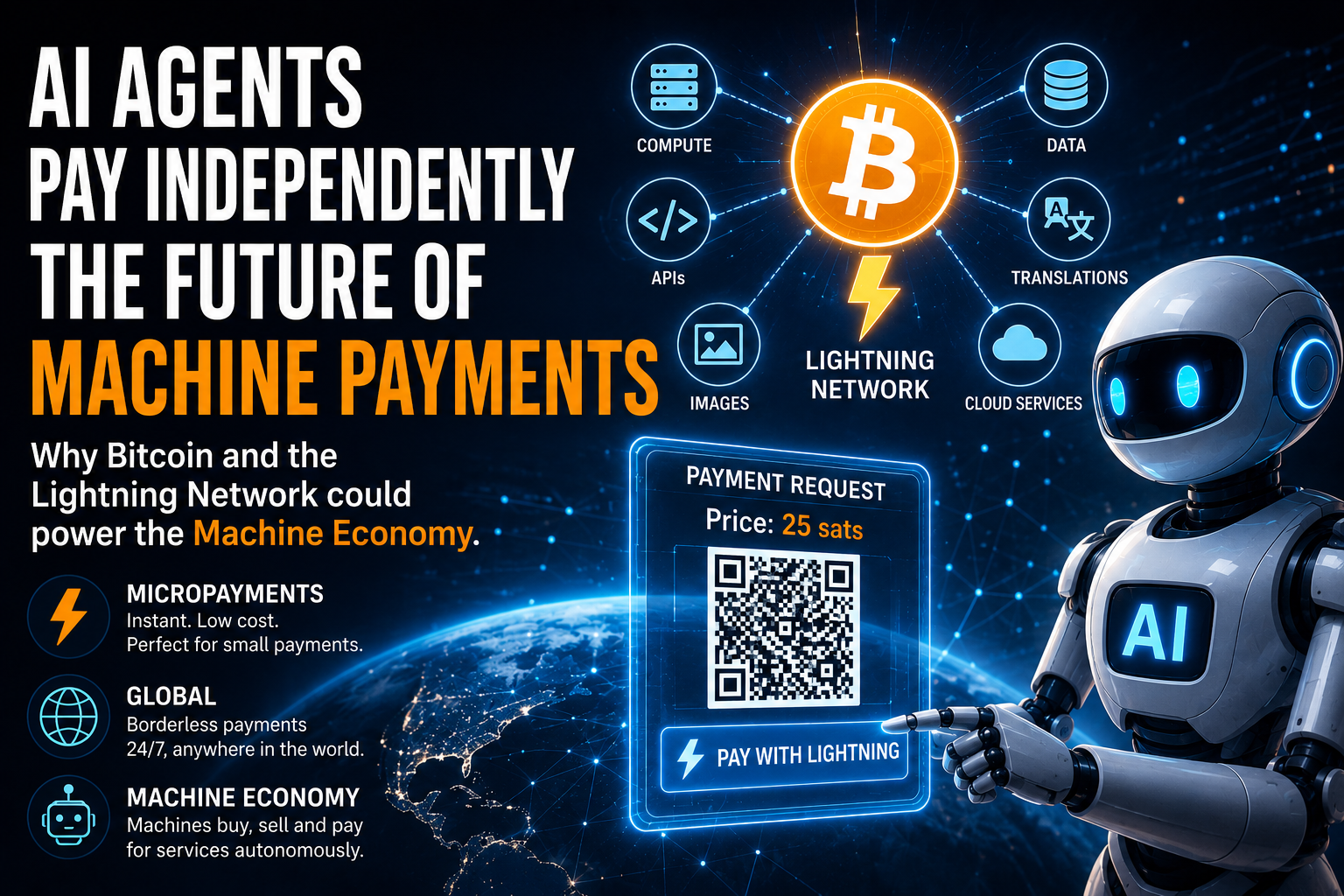
AI Agents Make Payments on Their Own—Why Bitcoin and the Lightning Network Could Be the Future of Autonomous Micropayments
AI Agents Make Payments on Their Own—Bitcoin & Lightning for the Machine Economy
In the future, AI agents will independently purchase computing power, APIs, and digital services. Find out here why Bitcoin and the Lightning Network could serve as the infrastructure for micropayments and the Machine Economy.
AI Agents Make Payments on Their Own—Why Bitcoin and the Lightning Network Could Be the Future of Autonomous Micropayments
The development of artificial intelligence is currently advancing at an impressive pace. While ChatGPT, Claude, and Gemini are still primarily used as intelligent assistants today, companies such as OpenAI, Anthropic, Google, and Microsoft are already working on the next stage of evolution: AI agents.
In the future, this software will not only answer questions but also perform tasks on its own. It will schedule appointments, research data, create documents, purchase computing power, or use paid APIs—all without human intervention.
This raises an entirely new question:
How does software actually pay for digital services on its own?
However, the counterquestion is at least as intriguing: How can software make money on its own? After all, in the future, AI agents will not only be customers, but will also offer services themselves and be paid automatically for them.
This is exactly where Bitcoin—and the Lightning Network in particular—comes into play. Many experts see it as one of the most technically interesting solutions for the next generation of digital payments.
What is an AI agent?
An AI agent is a piece of software that makes decisions and performs tasks on its own.
Unlike a traditional chatbot, an AI agent doesn’t just wait for user input; it can act on its own.
For example, an AI agent could:
- Conduct research
- Book hotels or flights
- Buy Software
- Retrieve weather data
- Request Translations
- Generate images
- Book Cloud Computing Power
- combine various software services
The decisive difference:
The agent decides for itself which services it needs and performs them automatically.
Why do AI agents need their own payment system?
These days, people usually pay for digital services using:
- Credit cards
- PayPal
- Bank transfers
- monthly subscriptions
This works well for people.
Not for an AI agent, however.
Imagine that an AI agent needs the following for a task:
- Weather data for 0.3 cents
- A translation for 2 cents
- 20 seconds of GPU computing power for 5 cents
- Latest stock market data for 1 cent
Should the agent have to:
- create a user account,
- confirm his email address,
- provide a credit card,
- and authorize the payment manually?
Of course not.
A machine-driven economy requires a completely different payment infrastructure.
Why Traditional Payment Methods Are Unsuitable
Today’s payment systems were designed for people.
AI agents, on the other hand, require payments that:
- take place automatically,
- are completed within a few seconds,
- work worldwide,
- are available around the clock,
- get by without registering,
- can be integrated directly into software.
Above all, however, they must be able to process even the smallest amounts in a cost-effective manner.
After all, many digital services may cost only a few cents—or even just fractions of a cent—in the future.
What are micropayments?
Micropayments refer to very small payments—often in the range of a few cents or even less.
For credit cards or bank transfers, such amounts are hardly cost-effective.
The fees would often be higher than the actual payment amount.
In a world of autonomous AI agents, however, billions of such micropayments could be generated every day.
Examples:
- 2 cents for a translation
- 5 cents for generating an image
- 1 cent for current weather data
- a few cents for computing power
- Individual Satoshis for an API call
The Lightning Network was developed specifically for applications like these.
Why is the Lightning Network suitable for AI agents?
The Lightning Network is Bitcoin’s second layer and enables nearly instantaneous Bitcoin payments with very low fees.
Lightning offers significant advantages, especially for AI agents.
| Requirement | Traditional payment systems | Lightning Network |
|---|---|---|
| Micropayments | ❌ Only to a limited extent | ✅ ideal |
| Payments in seconds | ❌ Often slow | ✅ Almost instant |
| Available worldwide | ⚠️ Depends on the country | ✅ globally |
| Available 24/7 | ⚠️ Limited | ✅ 24/7 |
| Programmable | ⚠️ Limited | ✅ Fully API-compatible |
| Suitable for software | ⚠️ only to a limited extent | ✅ ideal |
Lightning enables software to process payments directly via programming interfaces—without the need for human intervention.
How AI Agents Pay with Lightning
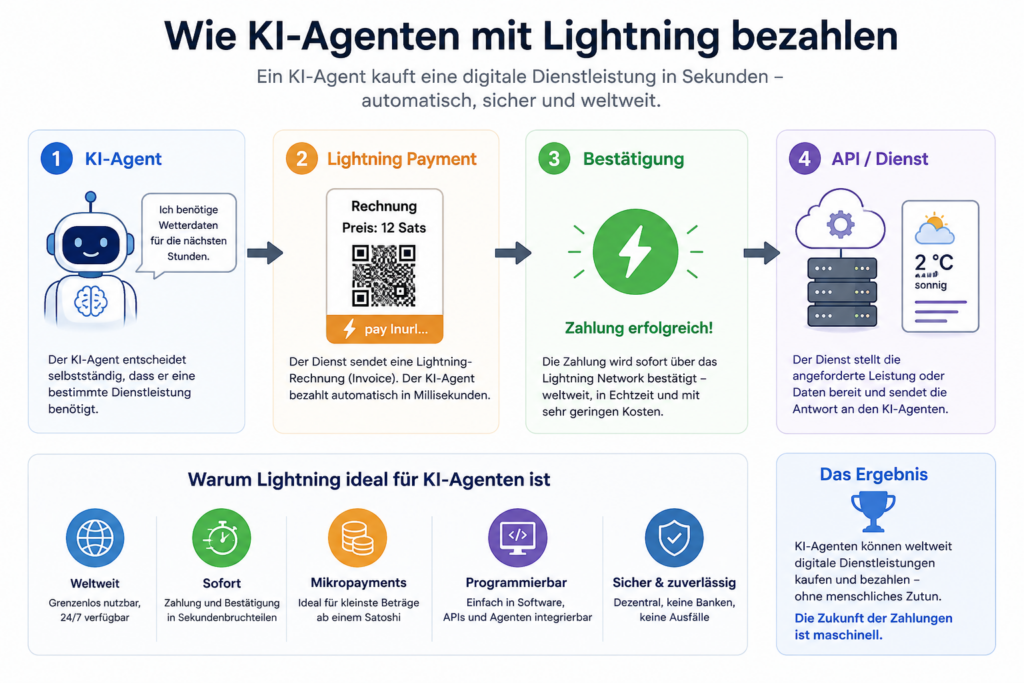
Software Pays for Software
It will be particularly exciting when it is no longer people who are shopping, but software that is trading with one another.
Here’s an example:
An AI agent is supposed to prepare a market report.
To do this, he needs:
- current stock market data,
- Weather information,
- Translations,
- Charts,
- and additional computing power.
Each of these services is used automatically.
Each provider delivers its service directly.
The AI agent pays for each individual service within a few seconds.
The entire process is fully automated.
This form of the digital economy is often referred to as the ” machine economy.”
AI agents are becoming service providers themselves
So far, we have mostly viewed AI agents as buyers of digital services.
Yet the much bigger development could be that AI agents themselves become providers.
Imagine an AI agent that specializes in translating technical documents.
Another agent creates graphics.
A third analyzes stock market data.
A fourth person checks software for security vulnerabilities.
All of these agents could offer their services online and be paid automatically for each individual request.
Not per month.
Not through a subscription.
But precisely when their services are used.
Example
A developer just needs a short translation.
Instead of signing up for a monthly subscription, his software calls up the appropriate AI agent.
The agent replies:
Translation of a document
Price: 15 satoshis
After a successful Lightning payment, the agent immediately provides the result.
The entire process takes only a few seconds.
That’s the key difference
Today, software companies typically make their money through:
- Monthly Subscriptions
- Annual Licenses
- Advertisement
- API Packages
In a machine economy, on the other hand, millions of individual services could be paid for directly.
Every request becomes a small transaction.
Then I would illustrate that visually.
| AI Agent | Offer | Price |
|---|---|---|
| Translation Agent | Translate 1 document | 15 sentences |
| Weather Agent | Get Weather Data | 2 sentences |
| Image Generator | Generate an image | 50 Sats |
| Programming Agent | Analyze Code | 80 Sats |
| Stock Market Agent | Current Market Data | 5 sats |
For the first time in the history of the Internet, software programs could not only spend money but also generate revenue on their own.
What does “Machine Economy” mean?
The Machine Economy refers to an economy in which machines, software, and AI agents make economic decisions independently.
It’s not people who buy services.
Instead, software buys software.
For example, an AI agent could:
- Buy Data
- Generate images
- Create Videos
- Licensing Music
- Sign Up for Cloud Storage
- Pay for APIs
- Subscribe to Software
- Assign other AI agents
Millions of such transactions could take place every minute in the future.
The first developments are already underway today
Even though this vision sounds futuristic, the first practical approaches already exist.
Coinbase and x402
With x402, Coinbase is developing a protocol designed to simplify digital payments between software applications.
This allows applications to automatically pay for paid services and use them immediately.
Lightning Labs and L402
With L402, Lightning Labs is taking a similar approach based on the Lightning Network.
The process is very simple:
- A software program requests a paid service.
- The provider automatically sends a Lightning invoice.
- The AI agent will pay this bill.
- Immediately afterward, he gains access to the desired service.
No user account or credit card required.
Brian Armstrong: “Bitcoin Will Be the Currency of AI Agents”
Coinbase CEO Brian Armstrong is also deeply involved in this issue.
In an interview with Peter Diamandis, he explained that in the future, millions of AI agents could make economic decisions on their own.
Armstrong distinguishes between two roles:
- Stablecoins could become an everyday means of payment for many transactions.
- He views Bitcoin as a long-term store of value and a reserve asset for this new digital economy.
It remains to be seen whether this vision will come true.
However, it shows that the industry’s largest companies are already working intensively on the payment infrastructure for AI agents.
Bitcoin or stablecoins?
It remains to be seen which technology will prevail in the long run.
There are currently two widely discussed approaches.
Stablecoins
Advantages:
- stable exchange rates
- Simple Pricing
- Widespread acceptance in the financial sector
Bitcoin via the Lightning Network
Advantages:
- decentralized infrastructure
- global availability
- No banks required
- very low transaction costs
- ideal for micropayments
- open and programmable infrastructure
It is quite possible that both systems will coexist in the future and perform different tasks depending on the specific use case.
What does this development mean for merchants and API providers?
For companies, this development opens up entirely new business models.
Until now, most of the customers have been people.
In the future, AI agents could also become customers.
This applies in particular to providers of:
- APIs
- Software as a Service (SaaS)
- Databases
- AI models
- Translation Services
- Image and Video Generators
- Cloud computing power
- digital content
Instead of offering monthly subscriptions, these services could be paid for on a per-use basis in the future.
For example:
- 3 satoshis per API call
- 20 satoshis per translation
- 50 satoshis per image
- 100 satoshis per video analysis
This gives rise to entirely new business models that would hardly be economically viable with traditional payment systems.
What opportunities are emerging for Bitcoin payments?
For companies that already accept Bitcoin payments or are developing related solutions, this trend could become an important market for the future.
While many payment providers focus exclusively on payments between individuals, a second customer group may be emerging:
Machines.
Don’t pay people.
Instead, software pays for software.
However, the payment infrastructure remains the same.
That is exactly why the Lightning Network could be much more than just a solution for fast Bitcoin payments between individuals in the future.
It could become the payment infrastructure for a global machine economy.
Today, payment solutions are primarily aimed at businesses and online retailers.
However, the Machine Economy is giving rise to an entirely new target audience:
AI agents and software services.
You’ll also need wallets.
You would like to receive payments.
You would like to issue invoices.
They want to manage their sales.
The requirements are virtually the same as those for an online store—except that the seller is no longer a person but software.
This could mean that the market for Bitcoin payments could expand in the future to include yet another sector in addition to business-to-consumer (B2C) and business-to-business (B2B):
Machine-to-Machine (M2M).
Conclusion
The real revolution may not lie in the fact that AI agents can pay on their own.
The biggest change might be that, for the first time, they are acting independently in economic matters.
An AI agent purchases data.
Another one sells translations.
A third one rents out computing power.
A fourth analyzes contracts.
Everyone pays and earns money—fully automated.
Bitcoin and the Lightning Network could be much more than just a new payment method. They could become the financial infrastructure of a digital economy in which machines not only communicate with each other but also conduct transactions with one another.
Frequently Asked Questions (FAQ)
What is an AI agent?
An AI agent is a piece of software that performs tasks and makes decisions on its own. Unlike a chatbot, an AI agent can independently use services, retrieve data, or purchase digital products.
What are micropayments?
Micropayments are very small payments—often in the range of cents or satoshis. They are particularly well-suited for digital services such as APIs, data, or computing power.
Why is the Lightning Network well-suited for AI agents?
Lightning enables fast, low-cost, and programmable Bitcoin payments. This makes it possible to transfer even the smallest amounts in a cost-effective and automated manner.
What does “Machine Economy” mean?
The Machine Economy refers to an economy in which machines, software, and AI agents independently buy, sell, and pay for services.
Will AI agents pay exclusively with Bitcoin?
No. Currently, both Bitcoin via the Lightning Network and stablecoins are being discussed as potential payment systems. It remains to be seen which solution will prevail in the long term.
Further information
Interview with Brian Armstrong (Coinbase) on AI Agents and Bitcoin on BTC-Echo
Brian Armstrong on Bitcoin, AI Agents, and the Machine Economy
Interview on the ” Moonshots with Peter Diamandis” podcast.
👉 https://www.youtube.com/watch?v=isd2y37j8v4
Lightning Labs – L402: Payment Authentication for the AI Economy
Lightning Labs is developing L402, an open protocol that enables APIs and AI agents to make payments automatically over the Lightning Network.
👉 https://lightning.engineering/l402/
Also highly recommended:
👉 https://lightning.engineering/posts/2026-02-11-ln-agent-tools/
Coinbase x402
The official documentation for the x402 protocol.
GitHub:
👉 https://github.com/x402-open
Brian Armstrong and Cloudflare have even founded the x402 Foundation for this purpose, to establish an open standard for payments between AI agents and web services.
Anthropic – Model Context Protocol (MCP)
The MCP is currently becoming the standard that enables AI agents to use external tools and services.
👉 https://modelcontextprotocol.io/
GitHub:
👉 https://github.com/modelcontextprotocol
OpenAI – Agents SDK
With the Agents SDK, OpenAI provides tools for developing autonomous AI agents.
👉 https://openai.github.io/openai-agents-python/
HTTP Status Code 402 – Payment Required
The HTTP status code 402 Payment Required, which was rarely used originally, forms the basis for L402 and x402.
Mozilla Developer Network:
👉 https://developer.mozilla.org/en-US/docs/Web/HTTP/Status/402
Other Recommended Resources
Coinbase Agentic Marketplace
A directory that will allow AI agents to discover and automatically pay for services in the future.
Cloudflare Pay per Crawl
Cloudflare is working to make websites accessible through micropayments rather than advertising or subscriptions—a potential building block for the Machine Economy.